Friday, June 16, 2017

Algebraic Topology finds an application in neuroscience


For fans of Algebraic Topology, here is a fascinating practical application in the exploration of brain structure, a good example of apparently arcane math suddenly finding uses in the so-called "real" world... 

Science Daily Article: 
 'Multi-dimensional universe' in brain networks

Wired Article:
The Mind-Boggling Math That (Maybe) Mapped the Brain in 11 Dimensions

 Blue Brain Blog Report:
Team Discovers a Multi-Dimensional Universe in Brain Networks 

Topology in Neuroscience
 
The image attempts to illustrate something that can not be imaged – a universe of multi-dimensional structures and spaces. On the left is a digital copy of a part of the neocortex, the most evolved part of the brain. On the right are shapes of different sizes and geometries in an attempt to represent structures ranging from 1D to 7D and beyond. The “black-hole” in the middle is used to symbolise a complex x of multi-dimensional spaces, or cavities.

Blue Brain Project / EPFL © 2005 – 2017.
All rights reserved 


The original paper is freely available at the Frontiers in Computational Neuroscience...

 Cliques of Neurons Bound into Cavities Provide a Missing Link between Structure and Function

This discovery was made by a team from the Blue Brain Project
a Swiss Brain Research Initiative. They have also provided videos about this research...


The Blue Brain Project also provides some general videos about their research...  


Fun video introduction to Algebraic Topology...


And a fun video introduction to Topology in general...


Saturday, May 27, 2017

Tuesday, May 9, 2017

Pioneering Physics Show The Mechanical Universe Now on YouTube


The critically acclaimed television series The Mechanical Universe… And Beyond, created at Caltech and broadcast on PBS from 1985-86, is now available in its entirety on YouTube thanks to the efforts of Caltech's Institute's Information Science and Technology initiative.


Explore the Open Culture Website for other free educational programs in a variety of media.  Open Culture editor Dan Colman scours the web for the best educational media. He finds the free courses and audio books you need, the language lessons & movies you want, and plenty of enlightenment in between.

Sunday, May 7, 2017

Interactive Human Evolution Timeline


The Smithsonian Museum of Natural History provides an

 Interactive Human Evolution Timeline

The Timeline is just a part of the Smithsonian's exciting and informative...


 Human Origins Program & Field Research

The Smithsonian’s Human Origins Program conducts field and lab research on the evolution of early human adaptations. Our key research partners are in East Africa and East Asia – especially in Kenya, China, and Indonesia. Our digs and studies in these regions, along with investigations by associates working in Ethiopia, Tanzania, India, Mozambique, among other countries, help generate scientific data on the long-term interaction of human ancestors with their surroundings. Curiosity about human origins drives our research. The research supports our effort to bring the latest findings to public audiences worldwide.

Wild Gorillas Compose Happy Songs - New Scientist


Wild gorillas compose happy songs that they hum during meals

Below is a link to the original research paper published by PLOS (Public Library of Science) which was founded in 2001 as an alternative to the growing constraints of traditional scientific publishing, the Public Library of Science (PLOS) rapidly evolved into a driving force in the Open Access movement...

Food-Associated Calling in Gorillas (Gorilla g. gorilla) in the Wild 

More information on gorillas...

The Animal Diversity Web provides an informative 

Gorilla Factsheet
 

Wednesday, May 3, 2017

Mathematics of Islamic Tiling Patterns


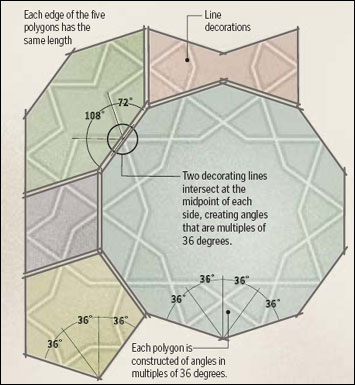
There is a fascinating article about the mathematics of Islamic tiling patterns as discovered by Peter J. Lu of Harvard University while visiting his cousin in the Peace Corps in 2005 in Bukhara, Uzbekistan. We owe a great deal to ancient Islamic mathematicians, not only their own work, but also their translation and preservation of Greek works that otherwise would have been lost.  The discovery is explained by Peter J. Lu in a video lecture...


The original article and interesting supplementary material is freely available... 


The Boston Globe has a helpful article on the five basic girih tiles... 


 For your own exploration of  Islamic Tiling Patterns, The Boston Globe Science Department provided some PDF files of the five basic girih tiles (shown above) that can be printed and cut out...


Shape 5: Hexagon

To create your own complex tiling designs online, Nikolaus Baumgarten provides an excellent and free browser-based 
  
GIRIH TILING EDITOR 

Baumgarten's great editor also has a feature where the tiles can have interlacing strapping lines:

Any tiling you do can be easily translated to this mode.  Here is one of mine:


Another interesting way to experiment with Girih tiling on your computer is using the free SketchUp program  
 
Google SketchUp is a free, fun, easy-to-use 3D modeling application.  Originally created for architects and designers, SketchUp is also a great tool for teaching geometry.
 

Any image editing software can be used to build fascinating girih tile patterns.  Below is a tiling I build up using the excellent and free open source image software Gimp:


And here is the final result:

If you look carefully at the above tiling, you can see the faint outlines of the five basic girih tiles:


In my tiling, I made them all blue in color to emphasize the overall pattern.  In Islamic tilings these five basic tiles can seldom be seen.  That is why their use was not known until Peter J. Lu noticed them.

The Great Lake Huron Rock Puzzle

  As a boy, I found this chunk of limestone on the shoreline of southern Lake Huron, Canada near the town of Goderich: The rock is 23 cm (9...