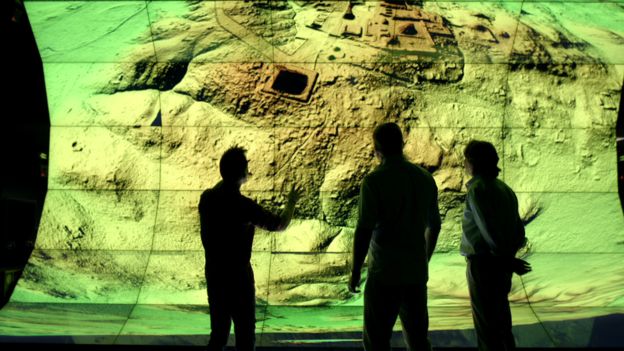
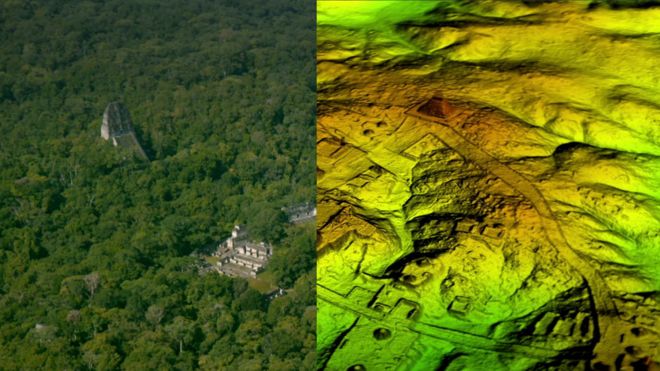
"Lidar is revolutionising archaeology the way the Hubble Space Telescope revolutionised astronomy," Francisco Estrada-Belli, a Tulane University archaeologist, told National Geographic.
"Using a revolutionary technology known as LiDAR (short for 'Light Detection And Ranging'), scholars digitally removed the tree canopy from aerial images of the now-unpopulated landscape, revealing the ruins of a sprawling pre-Columbian civilization that was far more complex and interconnected than most Maya specialists had supposed."
How Does Lidar Work? This NEON Science video overviews what lidar or light detection and ranging is, how it works and what types of information it can provide. The video was produced by the National Ecological Observatory Network - a non profit project devoted to open science and open data:
And in the UK: Archaeologists have discovered more than 3,000 historical sites and monuments in the New Forest thanks to Lidar (Light Detecting and Ranging). The technique beams harmless lasers into the ground to build a 3D map, revealing the hidden history of the New Forest including a Roman road:
This short film shows the landscape around Stonehenge as recorded by LIDAR survey (airborne 3D scanning). Millions of measurements were taken across the landscape, and here they have been turned into a 'solid' computer model to show how well the archaeology is recorded by this method:
A website set up by the US Geological Survey and intended to "facilitate data access, user coordination and education of lidar remote sensing for scientific needs":
Many
consider probability to be just calculations based on common sense, but
the Monty Hall problem is a clear example of how even a simple problem
can have a counter-intuitive solution:
Game Show or Monty Hall Problem
Suppose
you're on a game show, and you're given the choice of three doors:
Behind one door is a car; behind the others, goats. You pick a door,
say No. 1, and the host, who knows what's behind the doors, opens
another door, say No. 3, which has a goat. He then says to you, "Do you
want to pick door No. 2?" Is it to your advantage to switch your
choice? In 1990
Marilyn Vos Savant had this problem sent in to her "Ask Marilyn" column
for Parade magazine. The problem is easy to state but the answer
Marilyn provided was counter-intuitive and unleashed a storm of
controversy...
Around 2003 the following meme made its appearance on the Internet. The idea was NOT to puzzle the words out like a newspaper jumble, but to relax your mind and actually read them:
This text does not refer to any true research project that was conducted at the University of Cambridge, and probably the author who drafted the preceding paragraph chose the name “Cambridge University” at random. Since its first appearance in 2003, the original English text has been translated into dozens of languages, demonstrating how reading is universally resilient to jumbled letters. The name “Cambridge” stuck, and the phenomenon of being able to read words with jumbled letters without much effort is thus often labeled “the Cambridge University” effect.
Matt Davis of the Cambridge University MRC Cognition and Brain Sciences Unit published a page that attempts to trace the origin of this research...
Matt Davis believes that the original demonstration of the effect of letter randomisation was provided by Graham Rawlinson who in turn responded by providing a summary of his PhD thesis on this subject...
Judy Mandell noted in The Observer in an article on "Chunking" that "Typoglycemia" is starting to develop an interested following in the research community:
Here is what it comes up with for the opening of a famous novel:
It was the bset of tmeis, it was the wrost of temis, it was the age of wsiodm, it was the age of fsohelsonis, it was the epcoh of bieelf, it was the eocph of icrledtuiny, it was the sasoen of Lgiht, it was the saeosn of Deankrss, it was the sprnig of hpoe, it was the weintr of daspeir, we had ehertvinyg borefe us, we had nohintg bforee us, we wree all gniog dircet to Heaevn, we wree all giong dierct the otehr way -- in sorht, the poierd was so far lkie the psrneet piroed, taht smoe of its nesoiist ahiuioterts iienstsd on its bneig rvieeecd, for good or for eivl, in the srauelptvie dergee of csiomrpaon olny.
A helpful video by Matt on the Conjecture Channel that summarizes the history of the Cambridge History Effect:
Annother educational and entertaining video on typoglycemia and the psychology of reading by Vanessa Hill on the BrainCraft Channel:
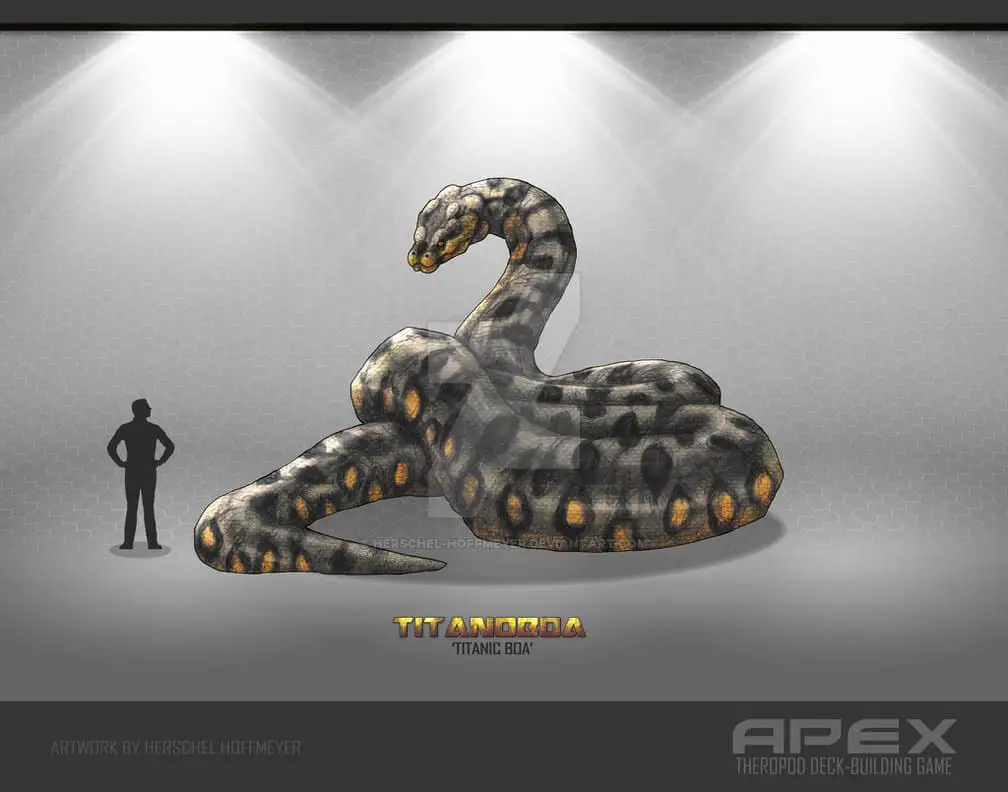
From the Smithsonian: Lord of the prehistoric jungle was a truly spectacular creature—a snake more than 40 feet long and weighing more than a ton. This giant serpent looked something like a modern-day boa constrictor, but behaved more like today’s water-dwelling anaconda. It was a swamp denizen and a fearsome predator, able to eat any animal that caught its eye. The thickest part of its body would be nearly as high as a man’s waist. Scientists call it Titanoboa cerrejonensis...
It's great to head down to the gym and get a good workout, but it's also great to do the same for your brain: to work on a challenging problem or puzzle. A very absorbing logical and arithmetical puzzle is the variation on Sudoku called KenKen:
Here is my detailed solution for the above problem:
There is an excellent KenKen web site with many playing tips and tutorials, as well as puzzles at many difficulty levels that can be solved online: KenKen Official Site
An interview with Tetsuya Miyamoto, math teacher and the creator of KenKen:
From the Official KenKen Site, a brief "How To" video:
Another excellent introduction by Bill Lombard, this time specifically for the 4x4 KenKen Puzzle:
Hooked now? Another problem with a detailed solution:
A detailed step-by-step solving of the above problem:
Many web sites provide more KenKen type puzzles to solve. One of the best is the site of that great online Puzzle Master: Krazy Dad. He calls his version of these problems "Inkies":
Now considered one of the first musical instruments invented in Colonial America, the Armonica is a little known invention of Benjamin Franklin. It is based on the principle of creating a musical note by running a dampened finger around the rim of a crystal glass or bowl. Franklin often brought the armonica on his travels and noted that: "Of all my inventions, the glass armonica has given me the greatest personal satisfaction."