Saturday, May 25, 2019

Birds of Prey: Haast's Eagle


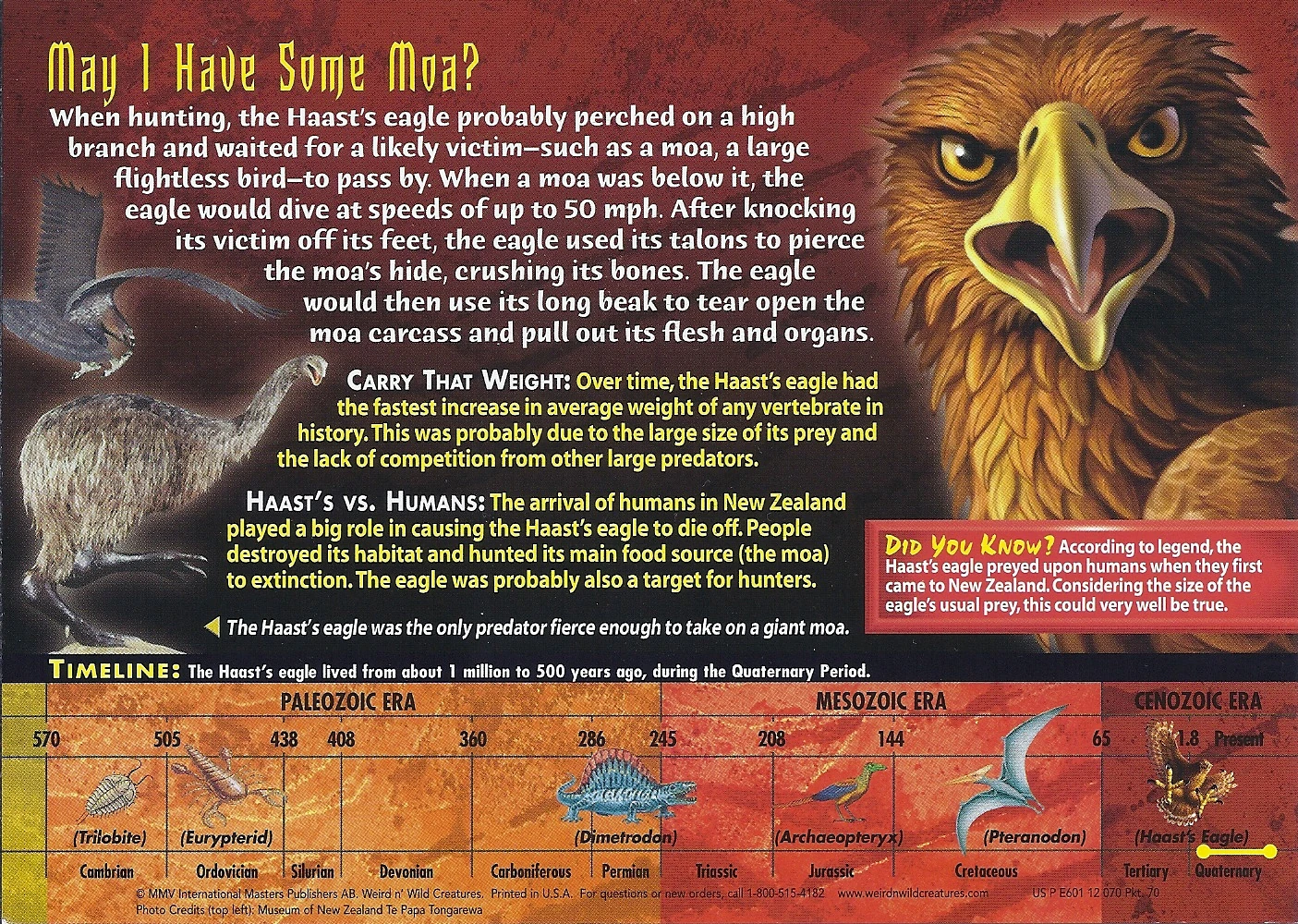
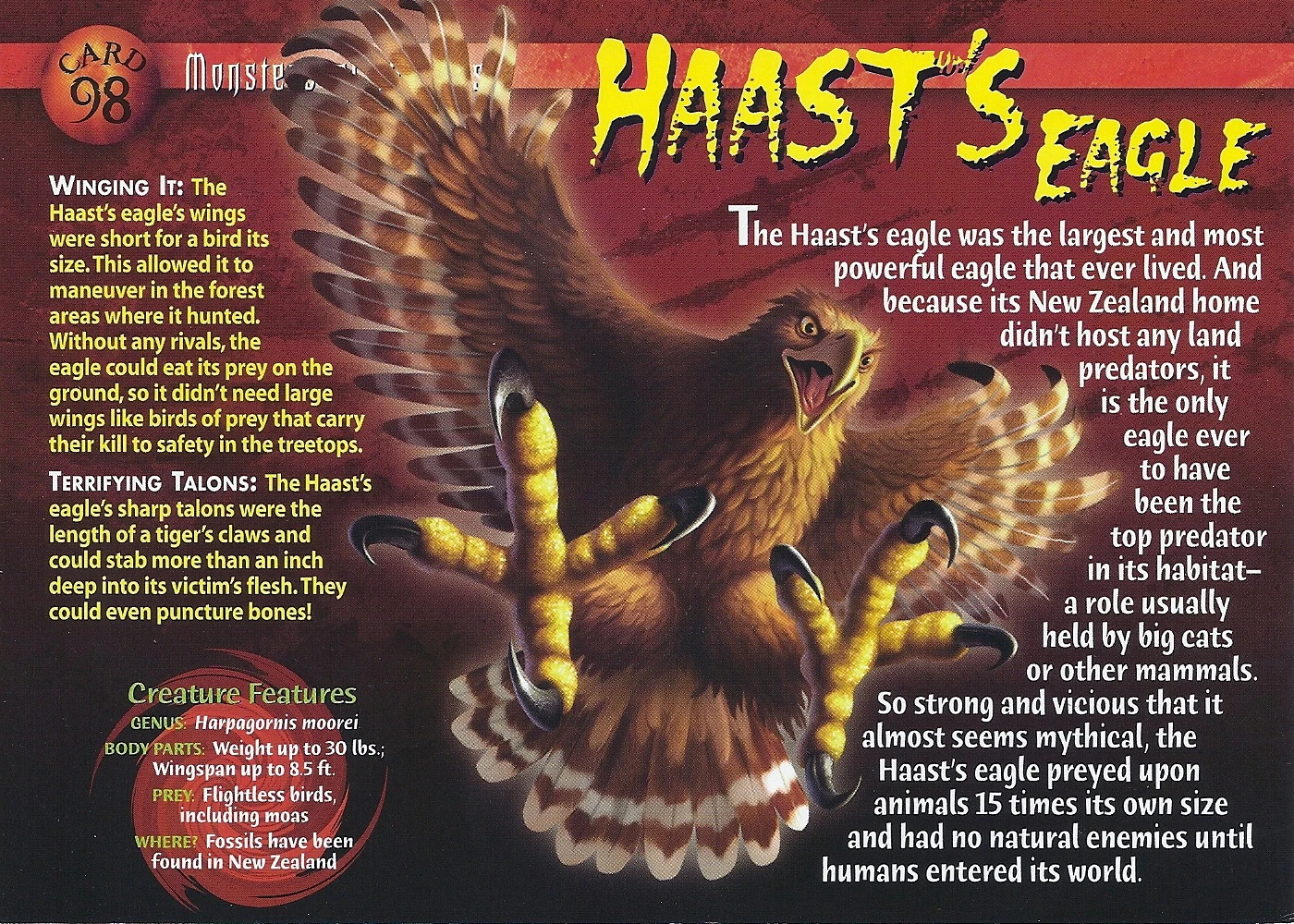
Haast's Eagle Monsters of the Past Card 98 front

Haast's Eagle Monsters of the Past Card 98 back

The extinct Haast's Eagle is currently considered to be the largest eagle to have ever lived and so has led a sensational afterlife as in the Monsters of the Past trading cards above. 

Haast's Eagle is named for Julius von Haast, the German geologist and explorer who was the first  curator of the Canterbury Museum in Christchurch, New Zealand.  He studied the bones of this giant bird and named it Harpagornis Moorei in honor of his friend and benefactor P. H. Moore of Glenmark, New Zealand where the bones were found.

His interesting article on the Harpagornis Moorei from 1871 can be found in the Internet Archives: 

Transactions and proceedings of the New Zealand Institute, Volume 4 - page 192


The Cenozoic Life Blogspot has an excellent page on Haast's Eagle including the size comparison below:


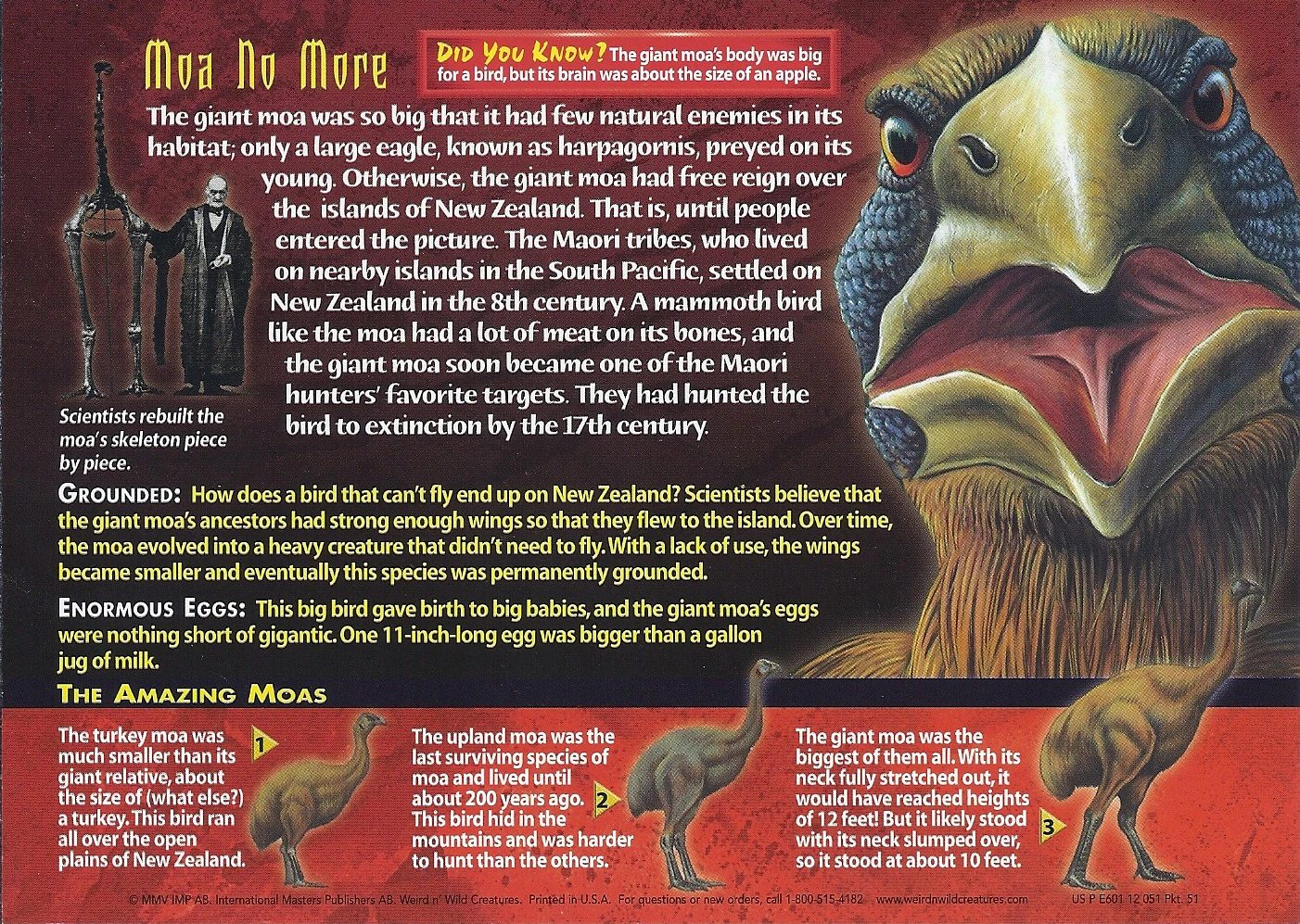
It could be found only on the South Island of New Zealand and is believed to have become extinct around 1400 AD due to the arrival of humans on the island and their hunting to extinction of Haast's Eagle's primary prey, the Moa, a large flightless bird:
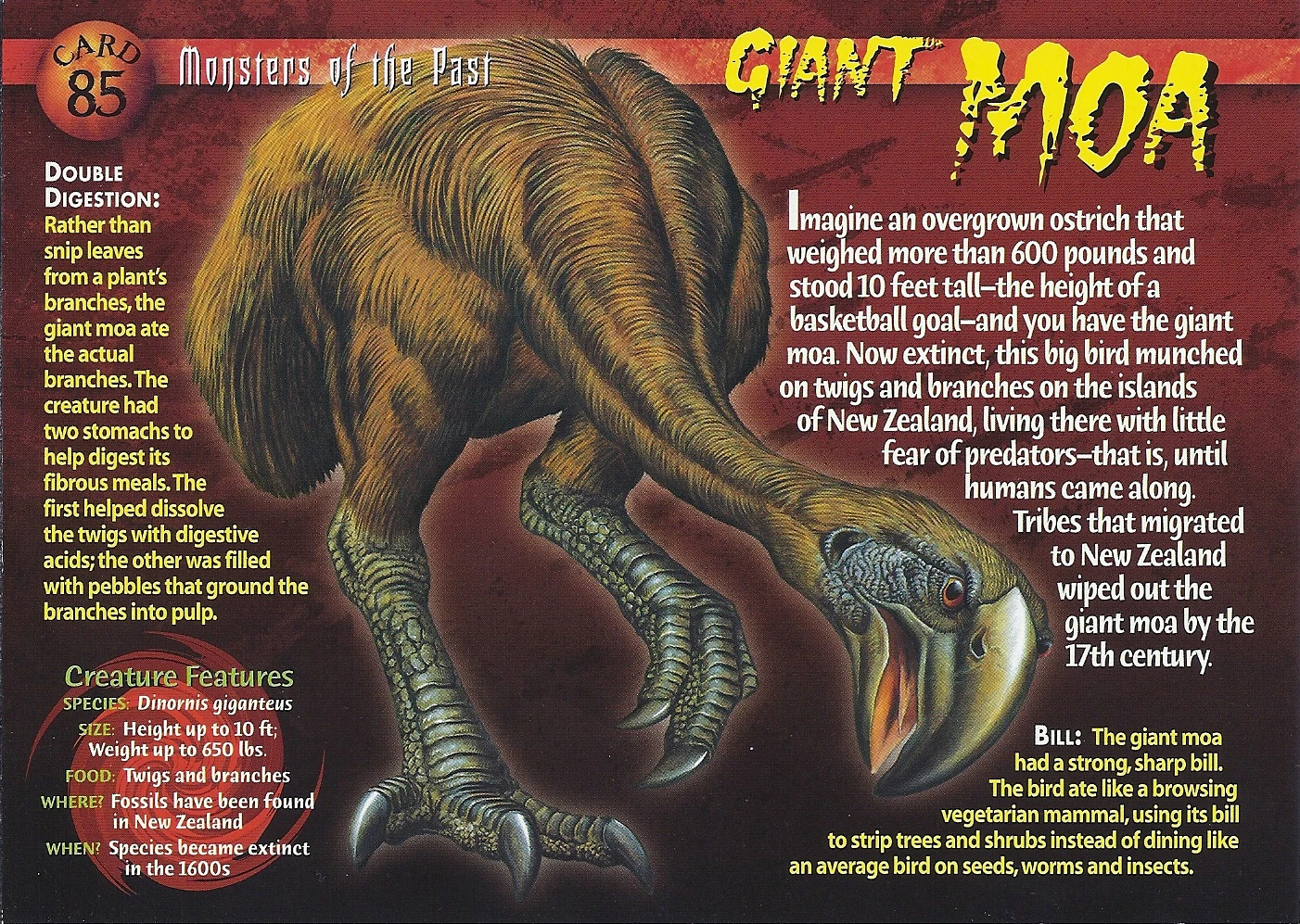
Giant Moa Monsters of the Past Card 85 front

Giant Moa Monsters of the Past Card 85 back

The Cenozoic Life Blogspot also has an excellent page about the South Island Giant Moa including the following size comparison of man, moa and Haast's eagle:


New Zealand Geographic provides this image of the Haast's eagle attacking a giant moa:

Illustration by Colin Edgerley
Many scientists believe that the size of this eagle was due to an evolutionary process called Island Giganticism which is also considered responsible for the huge Komodo Dragon lizard.

 The Prehistoric Wildlife site has a good size comparison between Haast's Eagle, the modern day Swamp Harrier and Eyles' Harrier, another extinct New Zealand raptor that is also considered to be the result of island giganticism:


 Discovery Science:  The Haast's Eagle


Haast's Eagle was included in New Zealand's Bird of the Week Series:


New Zealand Birds Online has an excellent page about the Haast's Eagle:

Haast's eagle. Haast’s eagle (Harpagornis moorei). Image 2006-0010-1/37 from the series 'Extinct birds of New Zealand'. Masterton. Image © Purchased 2006. © Te Papa by Paul Martinson See Te Papa website

Model maker Jake Yocum and curator vertebrates Alan Tennyson explain the science and process that went into recreating a full-size model of the huge extinct Haast’s eagle, pouākai.  It will feature at the Museum of New Zealand in the new exhibition, Te Taiao | Nature. . 


Special thanks to Mark Berge for suggesting I add the Haast's Eagle to my Birds of Prey series.  I was only going to do living birds, but the Haast's Eagle was just too fascinating to resist!

Friday, May 24, 2019

Birds of Prey: Owls


Great Horned Owl (Bubo virginianus) at Reifel Migratory Bird Sanctuary. Delta, BC, Canada.
Photographed by Brendan Lally [CC BY 2.0], via Wikimedia Commons

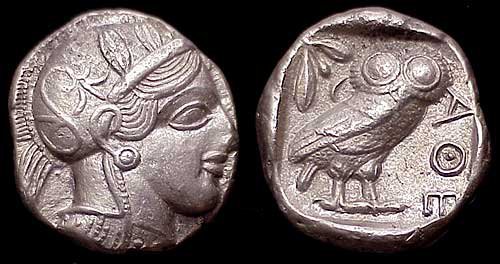
Owls, with their large, forward facing eyes seem striking, uncanny and almost human and this may help explain their powerful roles in such a wide variety of mythologies. 


The Owl Pages provides an overview of owls in myth and legend:


An Athenian Tetradrachm from after 499 BCE. CC BY-SA 3.0 Source


Art by Madeline von Foerster

Raptors that hunt by night or nocturnal birds of prey are exclusively made up of two sorts of owls:

The Owl Pages, a wonderful resource for all things owl, has a good summary page of the various owls included in these two families:


Peterson Field Guides provides a good summary of many aspects of the owl:


Cornell Bird Academy provides online courses and extensive information on owls:


Snowy Owl Invasion:  A Migration Saga


Owls have an amazing repertoire 
of distinctive calls:


Owls of North America and their calls provided by Close Encounters of the Bird Kind:


The BBC shows us how owls are also legendary for their silent flight:

Experiment! How Does An Owl Fly So Silently? | Super Powered Owls | BBC


Observe the graceful and unique flight of a barn owl in incredible slow motion:

Barn Owl vs Peregrine Falcon vs Greylag Goose | Super Powered Owls | BBC


Their amazing flying skills are used to defend their young against other predators such as Arctic 
Skuas and Wolves:

Master of the Sky: Owl Vs Wolf 

| Super Powered Owls | BBC


Watch the full Nature documentary on the extraordinary super powers of owls:


Robert E. Fuller the British wildlife artist likes to immerse himself in the daily lives of animals and birds to lend authenticity to his final paintings and sculpture.  Here he provides a fascinating video of barn owl nesting and family life:

Bringing Up Baby: How barn owls do it


The Owl Research Institute in partnership with Explore website provides a fascinating set of owl live cams:


Among many great books on owls, I would single out for special mention Canadian wildlife photographer and naturalist Wayne Lynch's Owls of the United States and Canada for his stunning photographs of North American owls in the wild, which he has often gone to extraordinary lengths to take... 

Monday, May 20, 2019

Birds of Prey: An Introduction to the Raptors


From the IBC Bird Collection.  Species: Andean Condor   Vultur gryphus
                                                      Author: Andy Wombat

                                                      Date: Monday, July 2, 2012
                                                      Added to IBC: 7 Feb 2013 - 14:41
There is still considerable controversy surrounding the various families that are considered to be raptors or birds of prey and how they are related.  In their Birds of Prey entry, Wikipedia has a good summary diagram that includes the families now considered to be raptors among the Telluraves, though the relations among them are still not firmly set:

From this classification, the raptors are divided into two groups:  

1.  Those that hunt by day or diurnal birds of prey: 

2.  Those that hunt by night or nocturnal birds of prey which are exclusively made up of two sorts of owls:

The Spruce provides a good summary of the raptors and their primary characteristics:


 The Spruce also provides some other interesting pages on raptors and their behaviour:


 Science Trek education site has a good introductory page on the various types of raptors and considers their primary characteristics to be:

  • hooked beaks with sharp edges
  • feet with sharp, curved claws or talons
  • keen eyesight

By this definition, raptors belong to three scientific orders:  the Accipitriformes,
the Strigiformes and Falconiformes. The orders are divided into six groups with a total of about 446 species worldwide. They include:

  • secretary bird (1 species in Africa)
  • falcons (63 species)
  • osprey (1 species)
  • hawks and eagles (226 species)
  • vultures (7 species)
  • owls (148 species)

Read more on these raptors at their site:


National Geographic provides an excellent documentary:

Wild Birds of Prey ( Raptors, Hawks, Falcons )


There are other documentaries that also provide a good introduction to birds of prey:

Eagle, Falcon, Owl - Birds Of Prey:

 Nature 2018 HD Documentary


Secret Nature - Facts About Birds of Prey 

| Bird Documentary | Natural History Channel


As usual the great Cornell Ornithology Lab site All About Birds has some excellent raptor info:

Tips for Raptor Watching Season


Sharpen Up Your Sharpie ID With New Crossley Raptor Guide


Raptors of Winter


New Crossley ID Quiz Challenges You to ID Raptors from Above 


A Hawk Watching Quiz on the Prairie

 Crossley Style


Q&A with Brian Sullivan

 Coauthor of Crossley ID Guide: Raptors


Do raptors make good neighbors?  Apparently...at least for hummingbirds: 

Raptors Make Good Neighbors

Hawks nearby? Good! This Black-chinned Hummingbird rests easy knowing that hawks will drive away (or eat) potential nest predators such as a raccoon or jay.    
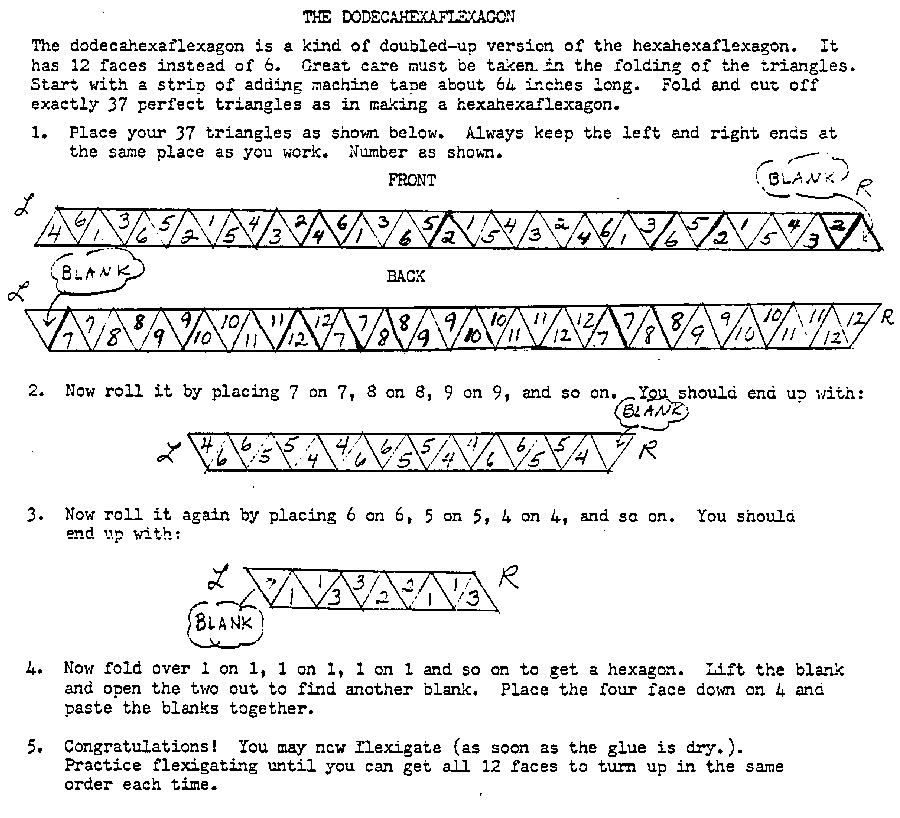
Photo © Ashley Cohrt


NOW VISIT VARIOUS BIRDS OF PREY:

Saturday, May 11, 2019

Birds of Prey: the Osprey


Photographed by Jay McGowan:  https://macaulaylibrary.org/asset/43425571

The Osprey fish hawk is found all over the world and is making a good comeback everywhere due to the intervention of environmentalists and reduced pesticide use and hunting.

Long been fascinated by ospreys. As a kid I found a dead one on the boulevard on the way to school. Wanted to give it to the local taxidermist, but he said it was such a large, beautiful specimen that he wanted to give it to the Royal Ontario Museum and their skilled taxidermists. And so we did that and it has been on display at the Royal Ontario Museum. 

Now there is a new beautifully illustrated book by one of the world's greatest living experts on ospreys: Alan F. Poole


The Explore.org website offers links to some great Osprey Nest Live Cams, including this majestic view in Montana:


The Cornell Ornithology Lab is unrivalled in its amazing pictures and information:


In the Kawartha Lakes region of Ontario, Canada there is an organization that befriends ospreys and provides much fascinating information on this majestic bird of prey:


The Birds of Prey YouTube Channel presents a short video of an osprey in flight as well as a fledgling just learning to fly:


BBC Scotland presents Ewan McGregor narrating over amazing slow motion footage of an osprey fishing:


Sunday, April 14, 2019

Best Websites for Learning Science


Gainmode.org has presented their top twenty websites for learning science:

 If you love science or are interested in learning more, you should check out our ‘top 20’ list of the very best websites where you can learn science for free. We have had a really good look at each website and have only included what we consider to be the very best:

Best Twenty Sites Where You Can Learn Science 


Here are links to the twenty sites they recommend:

NASA Official Website

Smithsonian

Scientific American Magazine

Science Daily Magazine

How Stuff Works

Science Direct

Nature Magazine

Space.com

Scitable

New Scientist Magazine

Science Magazine 

Popular Science Magazine 

TreeHugger.com 

Live Science 

Physics Central 

American Association for the Advancement of Science 

Science News 

NOVA 

National Public Radio 

Public Library of Science 


The How-to Geek has posted their selection of the


Real Clear Science has posted its recommendations for
 the top ten websites for science...


Sunday, January 27, 2019

Light Invisible: Exploring the Electromagnetic Sprectrum

It is very humbling to contemplate the electromagnetic spectrum and the tiny sliver that encompasses the full range of colors we can perceive:


For his Chemistry Lab, Ken Costello considered this to mean that in terms of the full spectrum we are indeed... 

spectrum
"The entire light spectrum (also known as the electromagnetic spectrum) spans light waves that are miles long to waves that are extremely short. The light we see (visible light) only spans about 1.5% of the entire light spectrum. So we would be legally blind considering what we could see." Experiment 7: Light as a Tool

To clarify the extent of this blindness, Ken Costello compared full spectrum perception to the color picture of a mountain scene (left) and then removed all but 1.5 percent of the color (right) to emphasize the 1.5 percent of the electromagnetic spectrum that we can actually perceive:


Clearly we are missing a lot and it is only by using powerful scientific instruments that we can find out what we are indeed missing.  The spectrum below displays the uses to which we put various wavelengths of the electromagnetic spectrum


For more on the above illustration, take the NASA Science:

Tour of the Electromagnetic Spectrum

Introduction:


Radio Waves:


Microwaves:


Infrared Waves:


Visible Light Waves:


Ultraviolet Waves:


X-Rays


Gamma Rays


But even though we humans are restricted to our narrow range of visible light, some animals are not!

ScienceAlert Article:

Birds Can See a 'Colour' Humans Can't.  Now Scientists Have Revealed This Hidden World.

The full text of the research paper by Cynthia Tedore and Dan-Eric Nilsson of the Zoological Institute, University of Hamburg:

Avian UV vision enhances leaf surface contrasts in forest environments

 
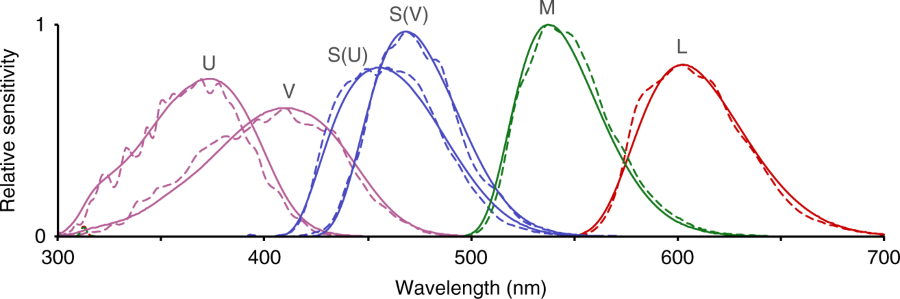
Spectral sensitivities of avian cones and multispectral camera channels. Solid lines show spectral sensitivities of avian cones and dashed lines show multispectral camera channels. Most terrestrially foraging birds are tetrachromats, having L, M, and either S(U) and U or S(V) and V cones6. L, M, S, V, and U stand for Long, Medium, Short, Violet, and Ultraviolet wavelengths, respectively


Thursday, January 24, 2019

Hexaflexagons, Hexahexaflexagons, Dodecahexaflexagons and Beyond!

Preambulist [CC0], from Wikimedia Commons

Flexagons came to public attention when the late great Martin Gardner (who wrote the excellent Mathematical Games column in Scientific American) did a column on them in 1956 which included a brief history:


One of the clearest descriptions of the procedure for making a hexaflexagon:


I made a hexaflexagon of this sort from stiff card stock paper.  At first I thought that this paper might make flexing difficult, but found that it actually makes it easier to flex.  Here is a brief video in which I flex through the three sides: yellow, purple and green:


A great flexagon resource page has been provided

Jürgen Köller's Flexagon Page 

Making a Hexahexaflexagon

A hexahexaflexagon is a hexagonal flexagon with six edges which can reveal six faces.  It can be made from a single strip of paper with 19 equilateral triangles.  For mine I used the following template printed twice on 8.5x11 card stock.  I then glued the two segments together by overlapping one triangle to give the needed 19 (which includes one as a flap for gluing).  This template gives a strip that is the width of a standard roll of clear packing tape, so before folding you can cover both sides with packing tape for extra strength:


The following video presents a good numbering system for making a hexahexaflexagon:


 The next video makes clear the final crucial phase of constructing a hexahexaflexagon:  the orientation and gluing of the flaps:


St Mary's University provides a PDF template for making this particular hexahexaflexagon:

St Mary's University also has a great Web Page on Flexagons.

Here is a brief flexing tour of my hexahexaflexagon that I covered with packing tape before folding:


For the above hexahexaflexagon you can make the following Feynman diagram of all the possibilities paired according to the colors of the front and back of the flexagon at that point.  You will notice that each pairing of front and back is unique, so taking up your hexahexaflexagon you will immediately know where you are on the diagram and how to flex to get anywhere you wish to go. The circles in the bottom right simply show all six colors available:


In the process of making a hexahexaflexagon, Vi Hart, the queen of flexagons describes the history of flexagons including Feynman diagrams that map the flexing relations and the Tuckerman traverse that provides a topological path to all six sides of the hexahexaflexagon:


Making a Dodecahexaflexagon
The dodecahexaflexagon is a particularly fascinating elaboration of the basic hexaflexagon.  It has twelve different faces.  Michael Anttila provides an excellent walk through of the twelve faces and twenty one states of the dodecaflexagon:


 Michael Anttila also provides a step by step video on the making of his marvellous dodecahexaflexagon:


For my dodecahexaflexagon I followed the following excellent instructions from David Pleacher:

I used card stock for the base and the same template as I used for my hexahexaflexagon above.  Instead of numbers I used smaller colored paper triangles in twelve colors and covered the whole strip with clear packing tape before folding.  Here is the result:


 I also made a Feynman diagram for my dodecahexaflexagon.  Each circle has the colors of the front and back of the flexagon at that point.  I named the outside areas after the related colors which are the hardest ones to flex to.  All twelve colors used are show in the bottom right:

 And beyond the dodecahexaflexagon, there are many other flexagon variations to explore, such as the amazing 3D origami moving flexagon, presented by Joe on the YouTube Channel:  How to Origami... 


I followed Joe's excellent instructions and made my first 3D Hexaflexagon.  I decided to make a number of models and for this reason made a template that made accurate folding easier:


In his instructions, Joe just tucked one side into the other, but I decided to make this easier and the result less thick and more flexible by creating a glue flap instead.  I printed this template on card stock, cut it out and made my 3D Hexaflexagon with four sides:  Red, Blue, Yellow and Black:


I made another 3D Hexaflexagon using brightly colored paper glued to cardstock.  I then covered the whole sheet of paper with clear packing tape.  The packing tape made folding more difficult and it took longer to flex it in, but the result was quite good:


Icosikaitetrahexaflexagon!

The icosikaitetrahexaflexagon has 24 sides, or 24 different faces to flex to.  Here is a brief description from teacher Danny Doucette:


 Richard Dibbs and his friends present an excellent video of how to make the icosikaitetrahexaflexagon:

The numbering for the triangles is given in the video description:


Finally, cbx33 presents a fascinating and complete walk through of the icosikaitetrahexaflexagon with progress shown on an inset Feynman diagram:


The Great Lake Huron Rock Puzzle

  As a boy, I found this chunk of limestone on the shoreline of southern Lake Huron, Canada near the town of Goderich: The rock is 23 cm (9...